
AI vocabulary map

The words that keep turning up in AI model news, sorted by the question each one answers, with an everyday comparison for each. No products and no model names.
The map sorts the words of AI model announcements under seven questions. Each word comes with an everyday comparison, a plain definition, and a question to ask a provider.
The terms are vendor-neutral. The map names no products or models and makes no recommendation. It covers the words you need to follow the news, so research terms are left out.
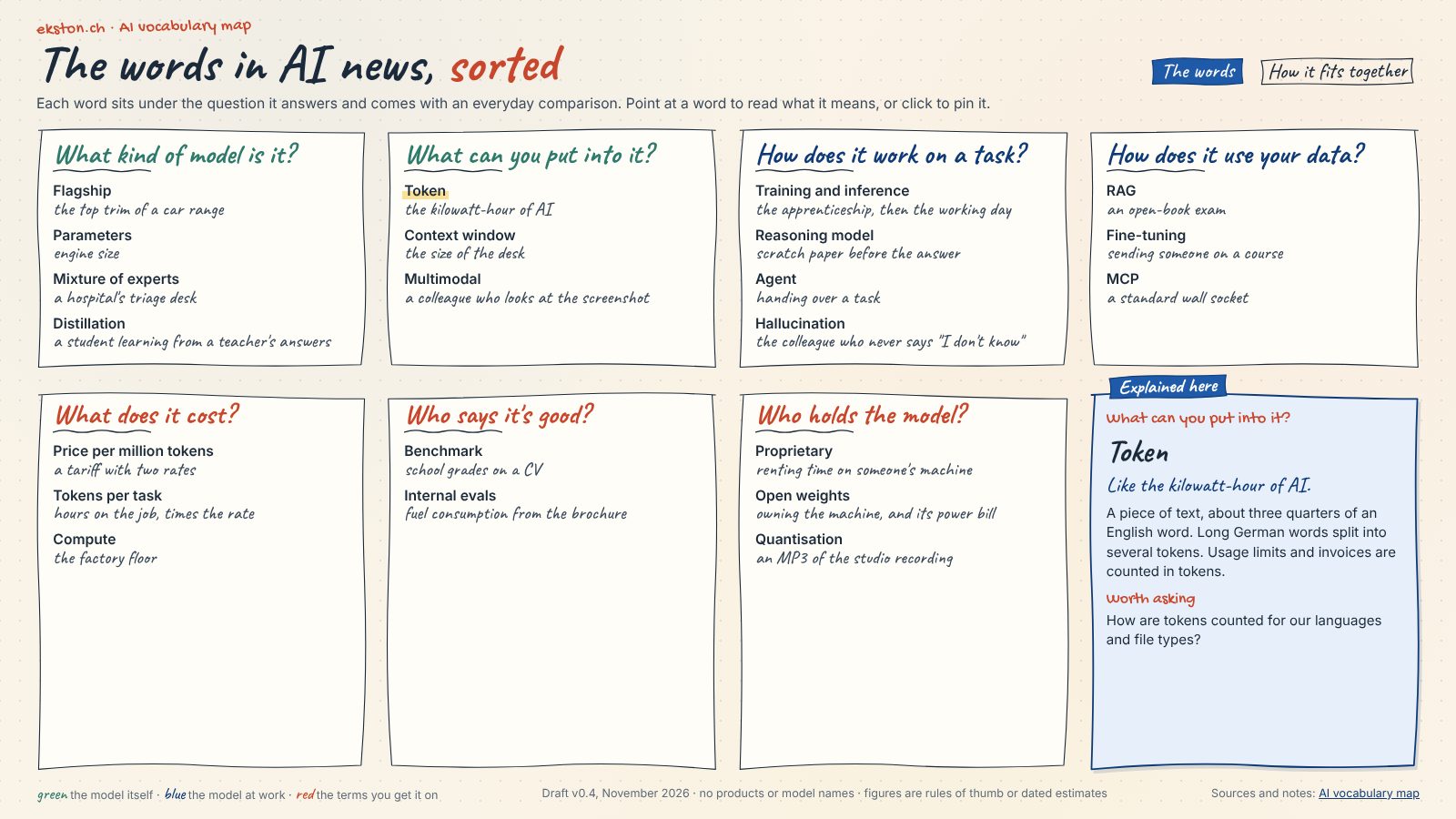
The image opens the interactive version, which fits on one screen.
Views
| View | What it shows |
|---|---|
| The words | Twenty-two terms under seven questions, each with an everyday comparison |
| How it fits together | The same words as a flow diagram in three lanes: a first mover, a fast follower, and Europe with Switzerland. Markers show where two common claims belong |
Word counts per token and the example prices are rules of thumb. The questions are a starting point for your own.
How it fits together
The second view is a flow diagram. The first lane follows the money from capital through compute, training, and the model to inference and what you use. Everything up to training is paid up front. Inference is paid per use. A second lane shows a fast follower on a smaller budget. The arrow between the lanes is distillation, where the first model’s answers become training material for the second.
I use the flow to place claims from discussions about AI and geopolitics. Here are two from a podcast.
“Regulate AI, and China wins the race.” This is the usual argument for light federal rules in the US.1 One school of thought replies that the US could regulate and keep its lead. It gives three reasons. China follows the US frontier, so racing ahead also pulls the follower along.2 China already regulates AI at home and, by several accounts, pursues a different goal.34 The proposed rules would cost little speed.5
The flow can only test the first reason, which is the distillation arrow. In September 2026, US agencies accused six Chinese firms of distilling US models at industrial scale.6 China’s commerce ministry rejected this and called distillation a widely used, neutral technique.7 One of the firms denied it for its latest model.8 A student model still needs its own training and research, and analysts disagree on how much of the progress distillation explains.910
The other two reasons concern rules and intent, which the diagram can’t settle. Much of China’s AI regulation is about content, such as the mandatory labelling of AI-generated material.11 It says little about caution on capability. The race side points to China’s investment plans12 and to a gap of only months.13 It reads the distillation evidence as a reason to protect the lead. Whether China would slow down if the US did is a forecast.
“Only US companies can afford to train flagship models.” This claim is about the up-front part of the flow. The spending gap is wide. Analysts expect the largest US tech firms to spend more than $700 billion on AI infrastructure in 2026, against about $105 billion for Chinese cloud providers.14 Moody’s puts the ratio at about six to one.15 “Only” goes too far. Chinese firms still spend well over $100 billion a year,16 and a US government centre estimated one leading Chinese model to be about eight months behind.13 Capital spending also pays for inference capacity, and export controls limit which chips a buyer can get. So the question to ask is whether the limit is money, chips, or power.
The third lane places Europe and Switzerland on the same flow. About two gigawatts of AI compute sit in the EU, roughly 5% of the global total.17 Public programmes are adding more. The EU has opened a tender for up to seven AI gigafactories and expects to name the winners in early 2027.18 Switzerland trained its own model on the national supercomputer in Lugano. A few European labs build models on much smaller budgets than the leaders, and the largest raised €3 billion in September 2026.19 The Swiss model is fully open and was built by EPFL, ETH Zurich, and CSCS.20 At the end of the flow, both are mostly buyers. Their levers are rules and the choice of where inference runs. Access can also depend on another country’s rules. In June 2026, US export controls suspended access to two frontier models for a few weeks.21
These assessments are dated. Check the changelog before you reuse them.
Used in
Changelog
| Date | Change |
|---|---|
| 16 Nov 2026 | v0.4: the explanation panel stands out from the question boxes, and the wording is simpler and shorter. |
| 16 Nov 2026 | v0.3: “How it fits together” gains a third lane for Europe and Switzerland. The first claim is reframed around regulation and the race argument. |
| 16 Nov 2026 | v0.2: one-screen layout in the site’s sketched style, an everyday comparison on every term, new terms (distillation, compute), and the “How it fits together” flow diagram with two worked claims. |
| 16 Nov 2026 | v0.1: first draft. |
TechCrunch, The race to regulate AI has sparked a federal vs. state showdown, 28 November 2025. ↩︎
Yonathan A. Arbel and Matthew Tokson, The AI Race Isn’t Real, Lawfare, 19 May 2026. ↩︎
Gary Marcus, When it Comes to AI Policy, Congress Shouldn’t Cut States off at the Knees. ↩︎
The Wire China, commentary on China and the AGI race. ↩︎
Astral Codex Ten, Why AI Safety Won’t Make America Lose The Race With China. ↩︎
BleepingComputer, US says Chinese firms extracted billions of tokens from frontier AI models, 9 September 2026, on the joint CISA, NSA, and FBI advisory. ↩︎
eSecurity Planet, NSA, FBI, CISA Warn of Industrial-Scale AI Model Distillation Attacks, 10 September 2026. ↩︎
Reuters, “Chinese military researchers tap US AI models to train defense systems”, 31 July 2026, read in a syndicated copy. ↩︎
The Decoder, Frontier Radar #4: China has caught up, so what’s left of the Western AI lead? ↩︎
Yage.ai, What “Distillation” Actually Does for Chinese AI Companies, survey dated 14 April 2026. ↩︎
BABL AI, An Analysis of China’s Growing Influence in AI Regulation. ↩︎
Crypto Briefing, GOP Rep. Guthrie warns against strict AI regulations at Decoded Summit. ↩︎
Al Jazeera, China vs US: Who is winning the AI race, in four charts, 24 September 2026. ↩︎ ↩︎
South China Morning Post, Chinese firms face pressure on AI investments as US peers’ spending keeps soaring. ↩︎
Caixin Global, Chinese cloud firms’ AI spending to trail US peers as infrastructure gap widens, Moody’s says, 4 September 2026. ↩︎
Rhodium Group, Examining China’s AI Financing. ↩︎
Bruegel, How can Europe address its pressing AI compute infrastructure shortfall?, policy brief, 2026. ↩︎
Open Access Government, Introducing the EU’s AI Gigafactories initiative. ↩︎
AI Magazine, Mistral AI: Sovereign AI and a €21bn Valuation Push. ↩︎
CSCS, Apertus 1.5: Building the next generation of open AI infrastructure, 24 July 2026. ↩︎
Anthropic, statement on Fable and Mythos access. ↩︎